

Chapter Three: Research Methodology and Design - Website Content Guide
3.1 Introduction
A preview of the chapter.
What to include:
- Purpose of the chapter
- Structure of sections
Example:
This chapter outlines the research methodology and design used to examine the association between classroom seating arrangements and student participation in Nairobi County's public secondary schools.
3.2 Research Methodology
The overall research approach.
What to include:
- Quantitative, qualitative, or mixed methods
- Justification of the approach
- Similar studies that used the approach
Example:
This study adopts a mixed methods approach, combining quantitative and qualitative data collection. Quantitative methods enable statistical analysis of relationships between variables (Creswell, 2014), while qualitative methods provide contextual understanding through narratives and observations. This approach is justified by the need to triangulate findings for validity (Tashakkori & Teddlie, 2010). A similar approach was used by Kimani and Orodho (2015) in their study on classroom practices in Kenyan secondary schools.
3.3 Research Design
The blueprint of your study.
What to include:
- Type of design (e.g., descriptive survey, experimental, correlational)
- Rationale for the chosen design
- Similar studies that used the design
Example:
This study employed a descriptive survey design to systematically gather data from a large population and describe the association between seating arrangements and student participation without manipulating variables (Kothari, 2004). This design is ideal for capturing opinions, behaviors, and frequencies in natural educational settings. A similar design was used by Muthee and Wachanga (2013) in their investigation of classroom environment factors influencing student outcomes.
3.4 Location of the Study
The geographical or institutional setting.
What to include:
- Specific area/school/region
- Rationale for choosing the site
Example:
The study was conducted in public secondary schools in Nairobi County, selected for their diverse demographics and instructional environments.
3.5 Target Population
The group from which data will be drawn.
What to include:
- Definition of population (e.g., Form 3 students)
- Estimated size and demographics
Example:
The target population comprised approximately 3,000 Form 3 students and 150 teachers across 20 public secondary schools in Nairobi County.
3.6 Sampling Procedures and Techniques
How participants will be chosen.
What to include:
- Sampling method (e.g., stratified, random)
- Rationale
- Similar studies that used the approach
Example:
A stratified random sampling technique was employed to ensure balanced representation of schools across sub-counties and gender diversity. Stratification enhances the precision of the sample by reducing sampling error (Mugenda & Mugenda, 2003). Teachers were purposively sampled for interviews due to their specific classroom roles, aligning with qualitative research principles (Patton, 2002). This dual approach was similarly applied in a study by Nyambura and Kibaara (2016) on school leadership and student engagement.
3.7 Sample Size
The number of participants.
What to include:
- Formula or method used
- Final sample figure
- Similar studies that used similar sample sizes
Example:
Yamane’s formula (1967) will be used to calculate a representative sample size, yielding approximately 340 student respondents. Additionally, 15 teachers will be purposively selected. This sample framework aligns with that of Mwangi (2018), who used similar parameters to study learning environments in Nairobi.
3.8 Construction of Research Instruments
What it is: Tools used to collect data.
What to include:
- Description of tools (e.g., questionnaires, observation schedules)
- Justification for tool selection
- Similar studies that used similar instruments
Example:
The study will utilize a semi-structured questionnaire with Likert-scale items for students, a checklist for observing classroom seating arrangements, and a semi-structured interview guide for teachers. The semi-structured format allows for consistency across participants while accommodating rich, contextual responses. These instruments will be modeled after Orodho (2009), who employed a similar combination to explore educational factors in Kenyan secondary schools.
3.9 Testing for Validity and Reliability
Ensuring tools are accurate and consistent.
What to include:
- Content and face validity approaches
- Reliability testing method (e.g., Cronbach’s alpha)
- Similar studies that used similar methods
Example:
A pilot study will be conducted with 30 students from non-participating schools to refine the questionnaire. Content validity will be assessed by education experts, while Cronbach’s alpha will be used to evaluate reliability, targeting a threshold of 0.70 and above. This validation method aligns with Wambugu and Changeiywo’s (2008) study on instructional methods.
3.10 Data Collection Methods and Procedures
- How data will be gathered.
What to include:
- Timeline, tools, and personnel
- Similar studies that used similar methods
Example:
Data will be collected over four weeks by trained research assistants. Students will complete questionnaires, while classroom observations and teacher interviews will be conducted by the researcher. A comparable approach was used by Karugu (2016) in her study of school climate and student outcomes.
3.11 Data Analysis Techniques and Procedures
How data will be analyzed and interpreted.
What to include:
- Analytical methods (e.g., descriptive stats, correlation)
- Software used (e.g., SPSS)
- Similar studies that used similar techniques
Example:
Quantitative data will be analyzed using descriptive statistics, Pearson correlation, and regression analysis with SPSS software. Qualitative data will be analyzed thematically. This mixed analysis technique was similarly employed by Mutisya and Makewa (2014) in their study on instructional technology.
3.12 Ethical Considerations
Ethical protocols observed in your research.
What to include:
- Consent, confidentiality, voluntary participation
Example:
Informed consent will be obtained from school administrators, teachers, and students. Confidentiality and anonymity will be maintained throughout the study. Ethical clearance will be granted by the university ethics committee, and authorization will be sought from the National Commission for Science, Technology and Innovation (NACOSTI) and the Nairobi County education office. These measures ensure compliance with national research guidelines and enhance credibility (Mugenda & Mugenda, 2003).
Need help refining your research design or choosing the right data collection and analysis techniques? Contact us for expert support in developing a robust Chapter Three that ensures methodological rigor and academic excellence.
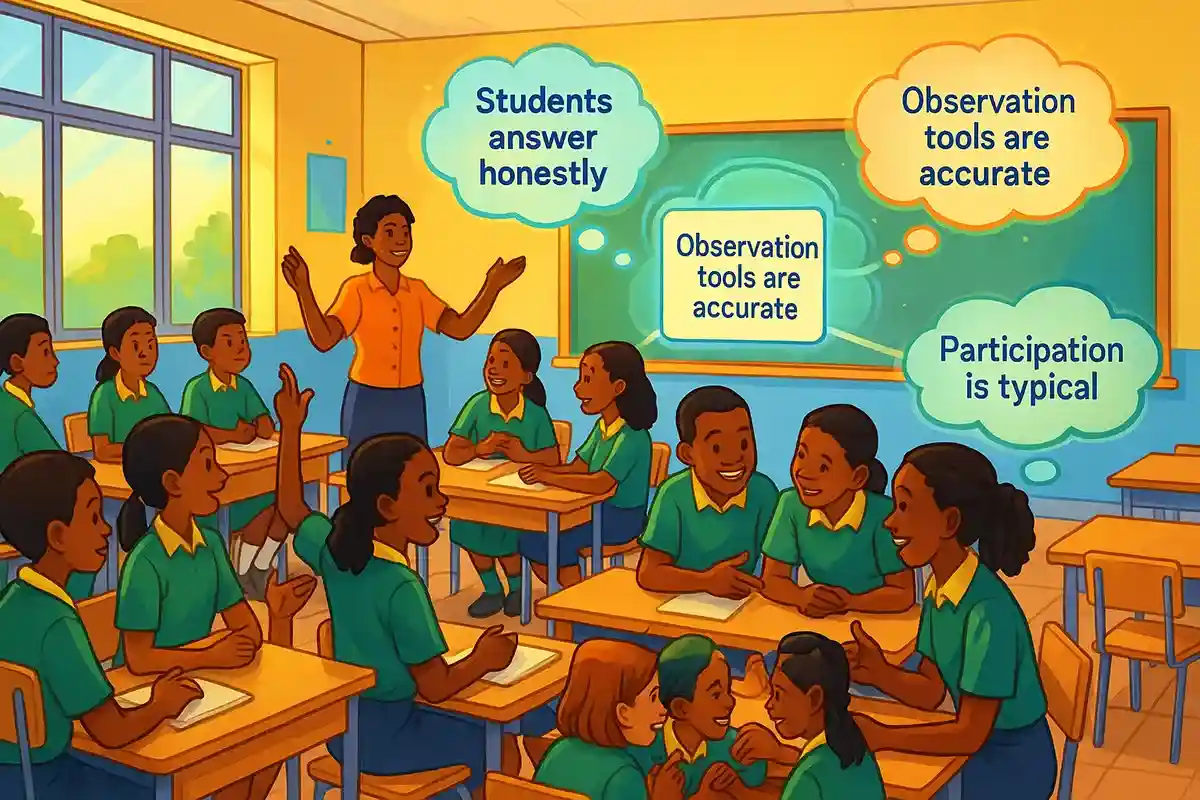 Understanding Research Assumptions: Insights from Seating and Participation in Nairobi Schools
 How to Write the Scope of the Study in Academic Research (With Example)
 Justification of the Study: A Practical Guide with Examples